Knights of the Air · Titre 3
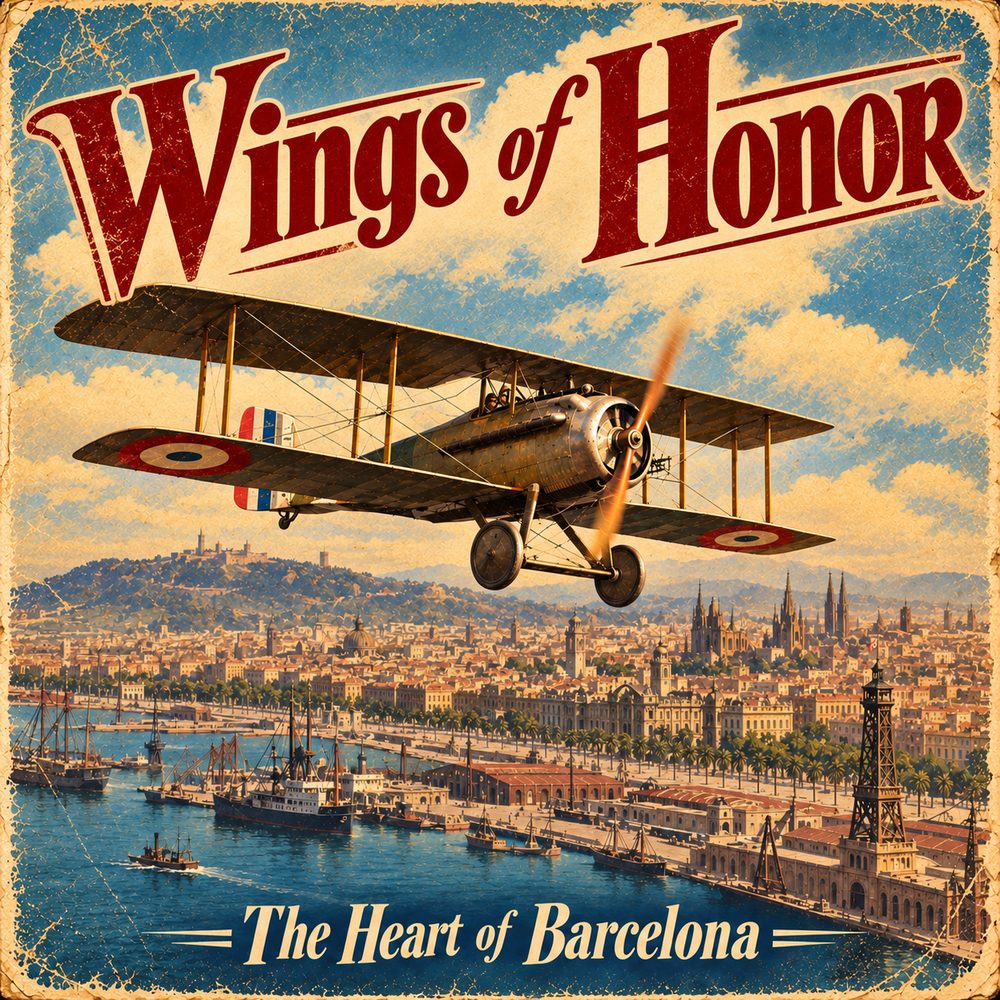
The Heart of Barcelona
Anglais · version catalane
L'histoire
Hispano-Suiza est fondée à Barcelone en 1904. Son nom réunit deux pays : l'entreprise est espagnole et son ingénieur en chef, Marc Birkigt, est suisse. Birkigt se fait d'abord un nom avec les automobiles, et quand la guerre éclate, il se tourne vers les moteurs d'avion.
Le résultat est l'Hispano-Suiza 8, qui apparaît en 1915. C'est un V8 à bloc en aluminium, léger et puissant pour son époque. Le concepteur français Louis Béchereau dessine le SPAD VII autour de lui. Le moteur équipe aussi le SPAD XIII, le Sopwith Dolphin et le S.E.5, parmi les meilleurs chasseurs alliés de la guerre.
La demande dépasse de loin ce qu'une seule usine peut produire. Près de 50 000 exemplaires sont construits, mais seulement 112 à Barcelone pendant la guerre : les autres sont fabriqués sous licence en France et dans d'autres pays, dont le Royaume-Uni, l'Italie et les États-Unis.
La chanson raconte cette histoire sur un air de valse, avec le moteur comme un cœur né « beside the Mediterranean sea ». Elle garde en tête la vraie proportion : la plupart de ces moteurs ont été construits loin de Barcelone, mais la conception, et le premier moteur, venaient de là.
Paroles · anglais
The Heart of Barcelona
Verse 1In a city by the sea, where the mountains meet the shore,
A Swiss engineer had a dream and wanted something more.
Spanish and Swiss, the name on the door,
Hispano-Suiza, and a V that would roar.
Pre-ChorusEight small cylinders, light as a breath,
An aluminum heart that would outrun death.
ChorusHeart of Barcelona, beating in the sky,
Eight cylinders singing as the fighters fly!
Heart of Barcelona, strong and free,
Born beside the Mediterranean sea.
Verse 2Nineteen fifteen, and the first one ran,
A fighter was drawn around the plan.
SPAD took the engine and the sky took fire,
And Allied pilots climbed a little higher.
Pre-ChorusEight small cylinders, light as a breath,
An aluminum heart that would outrun death.
ChorusHeart of Barcelona, beating in the sky,
Eight cylinders singing as the fighters fly!
Heart of Barcelona, strong and free,
Born beside the Mediterranean sea.
Verse 3From Paris to London, from Turin to the West,
Licences crossed the sea to build the best.
Nearly fifty thousand hearts were made,
But the first one beat where the first plans were laid.
BridgeUnder French wings, under British too,
The same Barcelona heartbeat carried them through.
Final ChorusHeart of Barcelona, beating in the sky,
Eight cylinders singing as the fighters fly!
Heart of Barcelona, strong and free,
Born beside the Mediterranean sea.
OutroBorn by the sea... beating still.
Paroles · catalan
The Heart of Barcelona (Catalan version)
Vers 1Entre Collserola i el mar, una fàbrica treballava,
un enginyer suís que un motor somiava.
Hispano-Suiza, dues terres,
i una V d'acer que rugirà.
Pre-tornadaVuit cilindres lleugers com un alè,
un cor d'alumini que venç l'aire.
TornadaCor de Barcelona, bategant al cel,
vuit cilindres canten quan les ales volen.
Cor de Barcelona, lliure i fort,
nascut vora el mar Mediterrani.
Vers 2Mil nou-cents quinze, ja arrenca,
un avió neix al seu voltant.
L'SPAD pren el motor, el cel s'encén,
els pilots aliats recuperen el cel.
Pre-tornadaVuit cilindres lleugers com un alè,
un cor d'alumini que venç l'aire.
TornadaCor de Barcelona, bategant al cel,
vuit cilindres canten quan les ales volen.
Cor de Barcelona, lliure i fort,
nascut vora el mar Mediterrani.
Vers 3De París a Londres, de Torí a l'Oest,
llicències que creuen el mar.
Gairebé cinquanta mil cors fets,
però el primer va néixer aquí.
PontAles franceses, ales angleses,
el mateix batec de Barcelona els va dur.
Tornada finalCor de Barcelona, bategant al cel,
vuit cilindres canten quan les ales volen.
Cor de Barcelona, lliure i fort,
nascut vora el mar Mediterrani.
OutroNascut al mar, bategant.